3I/ATLAS Thermal Jets Spark Alien Tech Debate: New Heat Maps Reveal Organized Patterns
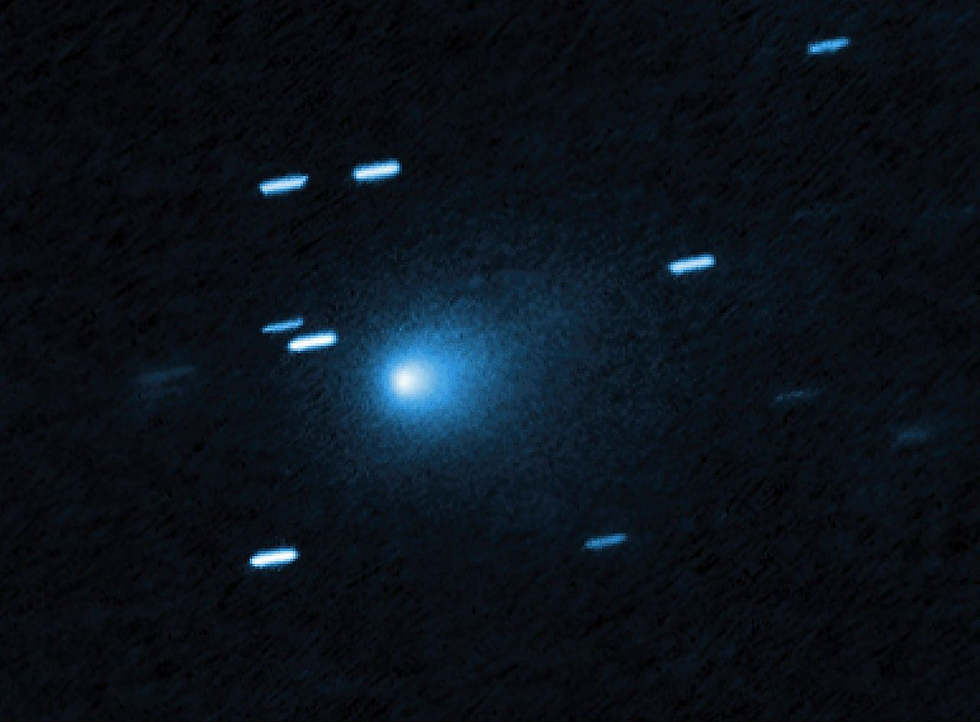
Unraveling the Mysteries of Interstellar Comet 3I/ATLAS's Unusual Activity
Interstellar comet 3I/ATLAS, a Manhattan-sized visitor from beyond our solar system, continues to captivate astronomers with its bizarre activity. Discovered in July 2025 by the ATLAS survey, the object reached perihelion on October 29 at 1.4 AU from the Sun. Recent thermal gradient imaging has exposed narrow, evenly spaced jets firing in repeating patterns, prompting questions about whether this reflects natural physics or engineered control.
Structured Jets Challenge Comet Norms
Thermal gradient techniques, which detect subtle heat variations on fast-moving objects, have revealed plumes on 3I/ATLAS that appear directional and periodic rather than chaotic. A November 29 capture from Rayong, Thailand, using a Larson-Sekanina filter, isolated two collimated jets emerging oppositely, alongside a sunward anti-tail defying solar radiation pressure. Unlike typical comets with diffuse outgassing, these features maintain linear vectors and symmetry, even after coma distortion removal.
Harvard astrophysicist Avi Loeb highlights the 16.16-hour pulsations, noting the nucleus’ size cannot alone cause such brightness swings; instead, rhythmic coma brightening suggests pulsed jets. Sunward projections, observed across Hawaii, Utah, Italy, and Spain, push dust against photon headwinds, implying internal propulsion. Ground telescopes like Joan Oró in Spain and Gemini North have captured spiral cryovolcanic structures, with jets extending up to 0.95 million km sunward and 2.85 million km anti-sunward.
Alien Technology or Natural Mystery?
The WION report underscores “shockingly organized” jets via heat maps, likening them to maneuvering bursts rather than vents. Loeb argues stable jet directions, independent of solar influence, cross into technological territory. No dust tail, chaotic spin, or fragmentation deviates from norms, with eerie uniformity hinting at a “flight plan”.
NASA’s multi-mission views, including Mars Reconnaissance Orbiter’s HiRISE, MAVEN, Hubble, and upcoming JWST December observations, confirm water ice, CO2, and cyanogen in the jets but puzzle over the order. Non-gravitational acceleration adds to anomalies, with mass ejections of 6-60 kg/s of dust grains.
Implications for Interstellar Research
As 3I/ATLAS nears Earth closest approach on December 19 at 1.8 AU, telescopes worldwide track its exit. These findings challenge comet models, urging refined studies of exocomets. While scientists urge caution—no firm alien claims— the patterns narrow possibilities, blending rigorous data with cosmic intrigue.


Comments